

Why this matters: Understanding how military organizations learn and adapt is crucial for navigating messy, complex conflicts where conventional strategies fail.
Attention: The Soup and the Knife
"To make war upon rebellion is messy and slow, like eating soup with a knife." – T.E. Lawrence
Imagine being handed a bowl of soup and a butter knife, then told to finish your meal quickly. That frustration mirrors the challenge conventional armies face when fighting insurgencies.
In his influential book, John A. Nagl uses Lawrence's quote to highlight a critical problem: conventional military forces are designed for fast, decisive battles (using spoons for soup), but insurgencies are messy, slow, and political (requiring a totally different approach).
Organizational Learning (Chapter 1)
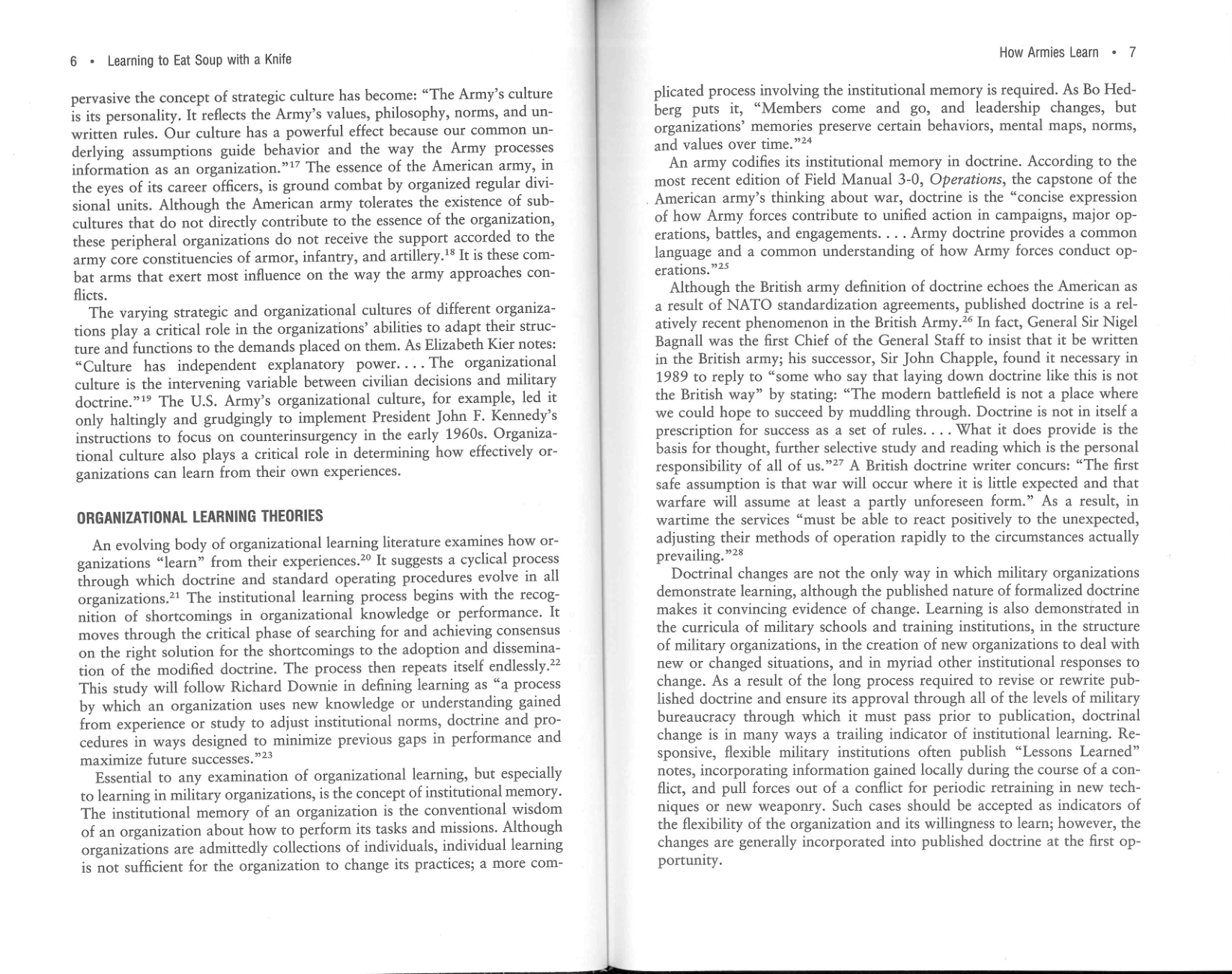
Nagl's primary thesis in Chapter 1 is that success in counterinsurgency depends heavily on an army’s ability to become a "learning organization."
A learning organization is one that can:
- Recognize when its current doctrine is failing.
- Gather feedback from the ground level.
- Adapt its strategies quickly to match the evolving reality of the conflict.
If an institution remains rigid and tries to force a conventional war framework onto an insurgency, it will fail.
Knowledge Check
According to Nagl’s introduction (Chapter 1), what is the most critical factor for an army to succeed in counterinsurgency?
Two Wars, Two Approaches
To prove his point, Nagl contrasts two major campaigns:
1. The British in Malaya: Initially, they struggled. However, the British Army adapted. They realized firepower wasn't the answer and shifted to separating the insurgents from the population, securing villages, and winning "hearts and minds." They learned.
2. The US in Vietnam: Conversely, the American military in Vietnam largely stuck to a conventional "search and destroy" strategy. Despite mounting evidence that this approach was failing against the Viet Cong insurgency, the institution resisted changing its core doctrine.
Hard Lessons (Chapter 9)
In Chapter 9, Nagl summarizes these "Hard Lessons." Why did the US Army struggle to adapt in Vietnam?
The failure was deeply institutional. The US military culture strongly favored technological solutions and conventional firepower. Changing this deeply ingrained culture to focus on population security and political nuance proved nearly impossible during the conflict.
The lesson is stark: an army’s culture and institutional rigidity can be its greatest enemy in an irregular war.
Knowledge Check
Based on Chapter 9, what was the primary reason the US Army struggled to adapt its strategy in Vietnam?
Key Takeaways
- The Metaphor: Counterinsurgency is like "eating soup with a knife"—messy, slow, and unsuitable for conventional tools.
- Learning Organizations: Armies must continuously adapt, gather feedback, and change doctrine to succeed in irregular wars.
- Institutional Culture: The British Army adapted in Malaya by changing its approach; the US Army in Vietnam struggled because its culture heavily favored conventional warfare and firepower.
- Flexibility over Firepower: Winning hearts and minds and securing the population often matters more than pure destruction in COIN.
Assessment
You have reached the end of the tutorial. It is time to test your understanding of John Nagl's "Learning to Eat Soup with a Knife".
This assessment consists of 4 questions. You must score at least 80% to earn the completion certificate.
Click Next to begin.
Question 1 of 4
What does T.E. Lawrence's metaphor of "eating soup with a knife" illustrate about counterinsurgency?
Question 2 of 4
According to Nagl's Chapter 1, what defines a "learning organization" in a military context?
Question 3 of 4
In his comparative analysis, how did the British approach in Malaya differ fundamentally from the US approach in Vietnam?
Question 4 of 4
Based on Chapter 9, what prevented the US Army from successfully adopting counterinsurgency tactics in Vietnam?